.png)


Why transparency will be a game-changer for people & culture
We’re very inspired by the trend to go transparent. It’s a real game changer for building trust, and does wonders for time-to-hire! If part of your KPIs includes increasing the eNPS and improving engagement, this could be your secret weapon.
We’re not only talking salary ranges in job adverts, but going all open (as far as possible) on processes, decision making, results, etc.
Why The World Of Work Needs Transparency
The absolute leaders pushing this trend are Adam Horne and John Faulkner-Willcocks, the co-founders of OpenOrg. So, instead of listening to us… learn from them why transparency is good for business, what “transparency-first culture building” looks like, and how people teams can and should operationalise more transparency across their business.

A bit of backstory on the team
Adam and John started Open Org because they saw the world of work failing.
After a break, Adam re-entered the job market, only to find the candidate experience littered with vagueness, lies, cover-ups and ghosting. Meanwhile, John had a mental breakdown after joining an organization that misrepresented its culture, team, and the role he was hired to do.
Together, they are now fiercely committed to rebuilding trust in the world of work, using transparency as the critical lever.
Why Transparency?
It’s what people want, and it’s good for business.
It’s What People Want
According to research, over 80% of team members want a better understanding of how decisions are made, and 87% of job seekers look for transparency in their future employer.
It’s Good for Business
Learnings from Open Org
Adam and John have worked with 100+ startup/scale-up leadership teams. Here are some key benefits they’ve seen People teams realise for their businesses:
Even though they typically work with progressive startups and scaleups, they’ve noticed that the bar is still very low, which means the opportunity to differentiate your culture and employer brand with transparency is huge.
Here’s a proof point to illustrate that, from the first cohort of 167 startups who leveraged their Open Culture Framework to identify how transparent their organisation was across 35 possible dimensions. As you can see below there’s a lot of room for improvement on areas which aren’t very hard to be transparent about in the 1st place!
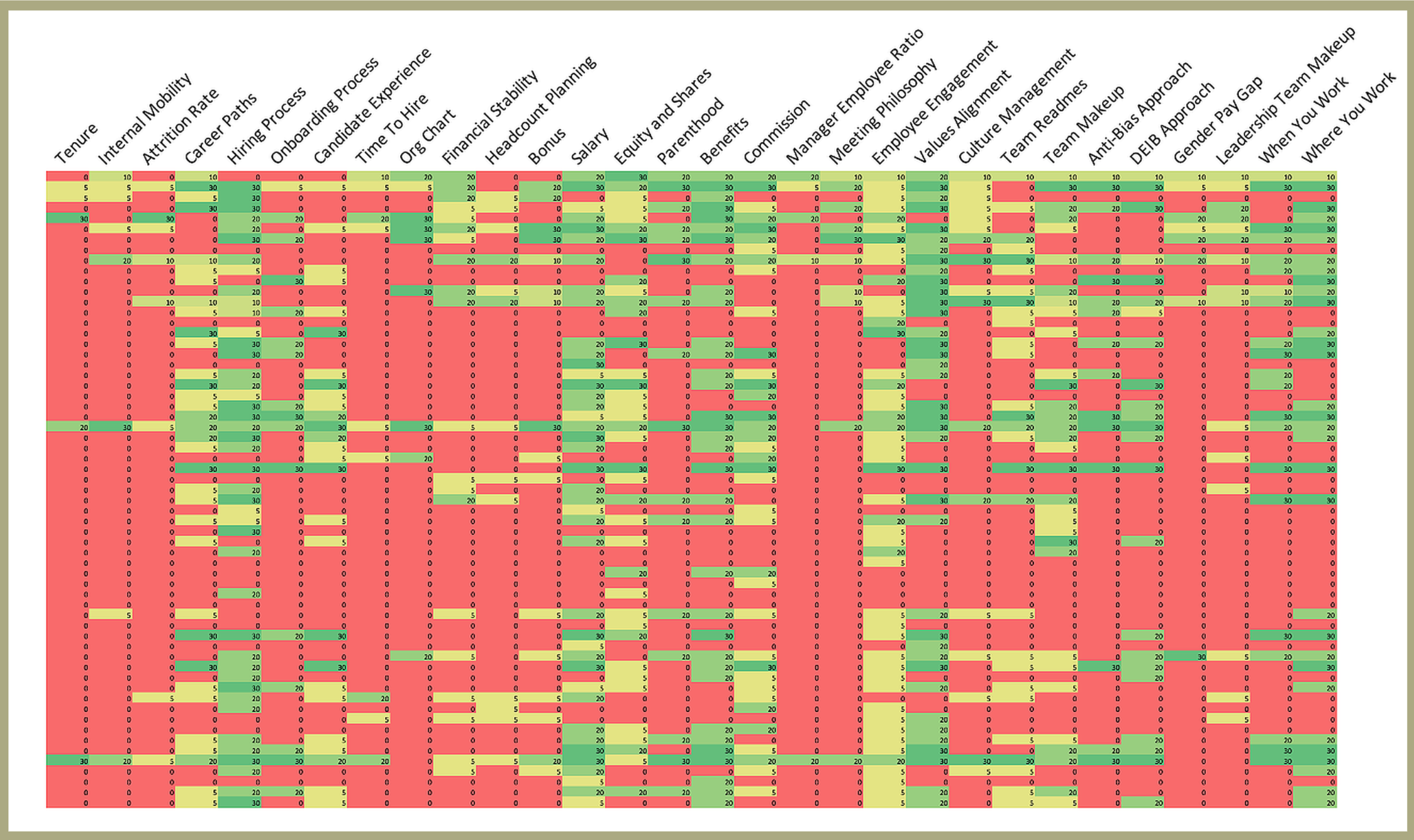
TL;DR – Operationalizing transparency is challenging and may seem daunting, but it doesn’t have to be. You can take small steps that will make big impact.
Common challenges that leadership teams face when considering increased transparency:
👉🏻 Lack of understanding and alignment on what transparency truly means for their organization, and how it will improve results.
👉🏻 Uncertainty about what to communicate, especially regarding complex topics like decision-making and business performance. They often worry ‘What if it’s too much?’.
👉🏻 Disconnect between people issues and business outcomes, which can be bridged by effectively using data and storytelling, trust us - people want the information. And they also need the right context and background to ensure they understand the data which is being shared!
Practical Steps You Can Take Today…
1️⃣ Heatmap Your Culture for Opportunities
Use the Open Culture Framework and their transparency assessment to create a roadmap of opportunities for increasing transparency in your org.
2️⃣ Analyze Your Data and Tell a Story
Connect the dots between what your people are saying (engagement data/feedback) and the opportunities identified in the Open Culture Framework. For example, if your data shows dissatisfaction due to a lack of transparency on funding and finances, use this insight to craft a compelling narrative for change.
3️⃣ Develop a Transparency Charter
Create a charter to define what transparency means to your business, why it’s important and what you do and don’t share. (Free template here.)
By following these steps, you can begin to embed transparency into your organization, fostering a culture of trust and engagement that drives business success.
Want some help with this? Join Open Org’s micro-community of culture builders or book a free discovery session to see their on-demand culture support in action. 🤘
Let’s build Irresistible Organisations by bringing more transparency into the equation.
.png)