


EU pay transparency unpacked
A few weeks ago at our 7people office we hosted a meet-up about EU pay transparency. We had a room filled with HR professionals who had a lot of questions: ‘Where do I find the right resources?’ and ‘How do I get my managers to take this topic seriously?’ as well as the cheeky ‘Will we really get fined if we don’t comply?’
Here’s the breakdown:
🇪🇺💶 EU Pay Transparency: Are we ready?
June 7th, 2026 was the original deadline for implementing the EU Pay Transparency Directive. It is now officially part of the European law, even if some countries, including the Netherlands, are still catching up. The Netherlands has cheekily delayed its national implementation to January 1st, 2027.
We know what you might be thinking: “The Dutch law isn't even in force yet. Can I just... wait?” Short answer: No. Long answer: also no, but with more context and a plan 😅.
Only 13% of organisations consider themselves fully ready. So if you're feeling a bit behind, welcome to the club, you're in excellent company.
The good news? The delay gives you extra runway to build the foundation properly, before enforcement begins. The not-so-good news? That runway is shorter than you think.
So: no stress. But also, no snoozing. Let's get into it.
WHY IS THIS LAW EVEN NEEDED?
This isn't new. Equal pay has technically been required in the EU since 1957. That's nearly 70 years of existing law, and still:
The gap also varies wildly across Europe: Latvia (19%), Austria (18.3%), and Germany (17.6%) are at the top. The Netherlands sits around 10.5 %. Belgium (0.7%), Italy (2.2%) and Luxembourg (which has effectively closed its gap) are at the bottom.
The uncomfortable truth? Without transparency, discrimination stays invisible. Pay secrecy doesn't protect employees, it protects inequality. The Directive exists to change that. Permanently. We’re actually fans here.
So what’s actually changing? The 4 pillars
The EU Pay Transparency Directive works on four interconnected levels. Here's what it means in practice for you as an HR professional:
🔍 1. Pre-employment transparency (Recruitment)
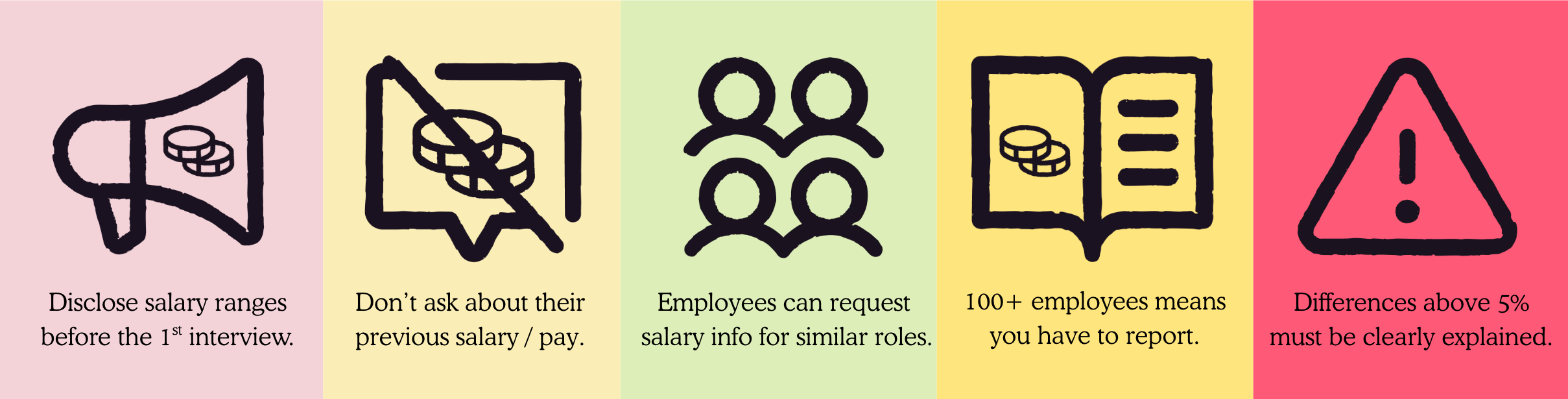
From now on, salary ranges must be disclosed to candidates, either in the job ad, or before the first interview. You don't have to publish exact salaries, but the range must be real and auditable. That means that most companies decide on having it in writing, either in the job description or in the email directed to the candidate.
Equally important: You can no longer ask candidates about their previous salary.
This practice has historically anchored pay inequalities: a woman who was underpaid in her last role would carry that underpayment forward, forever. That stops now.
Bonus: job titles and recruitment processes must be gender-neutral.
📬 2. Employee right to information
Employees can now formally request information about the average pay of colleagues doing comparable work, broken down by gender.
Employers must respond within 2 months. This is one of the areas where the Netherlands made a deliberate and notable choice: they explicitly prioritised transparency over privacy. That means even in small teams where an average could effectively reveal a specific colleague's salary, that data still goes out.
Also worth knowing: employees cannot be prevented from discussing their salary with each other. Pay secrecy clauses in contracts? No longer enforceable.
📊 3. Pay gap reporting
This is where company size starts to matter a lot:
What do you need to report on?
At a minimum:
💶 Unadjusted Pay Gap: Perhaps it is worth it to stop here for a second and explain what adjusted and unadjusted pay gap is. The unadjusted gap is the raw difference in average pay between men and women across your company. The adjusted gap controls for factors like role, seniority, and working hours. Both matter. The Directive requires you to report the unadjusted gap, but your ability to explain it relies on the adjusted analysis underneath.
⚖️ 4. Joint pay assessment
If your reported gender pay gap exceeds 5% and you cannot explain it using objective, gender-neutral criteria, you're required to conduct a joint pay assessment, together with employee representatives (your works council, in the Netherlands). What counts as objective criteria? Tenure, performance, time in profile, and legacy pay can all be valid. What doesn't count? Anything that cannot be formally documented.
The foundation you ABSOLUTELY need: JOB ARCHITECTURE
Before you can report, disclose, or defend anything, you need a solid job architecture. That means a structured, documented system of job families, levels, and profiles that defines what “work of equal value” means inside your organisation.
Your leveling-framework should be built on objective, gender neutral factors: Skills, Effort, Responsibilities and Working Conditions. These determine job levels, which determine pay bands, which determine what you can defend.
If you don’t have this in place yet, it’s where we recommend you start. If you already have a job architecture, check if it’s up-to-date and complies with the requirements above.
🙋🏻♀️ WHAT DO I REALLY HAVE TO DO?
0 – 100 employees
You're largely exempt from reporting obligations, but not from the recruitment and right to information rules. Start by documenting how you make pay decisions. Make sure you can answer the question: “Why does this person earn what they earn?” If you can't, that's your first task.
100 – 250 employees
You must publish pay progression and pay-setting criteria. Employees will ask questions, your managers need to be able to answer them. Build a job architecture, even if it's simple. And train your managers on how to have pay conversations.
250+ employees
All of the above, plus begin preparing for pay gap reporting. Audit your data. Identify unexplained gaps now, while you still have time to address them.
Here's the thing people don't say enough: a gap is normal.
Tenure differs between employees. Actual roles differ. Seniority differs. The Directive doesn't require you to have zero gap or be below 5%, it does require you to be able to explain the gap you have, using objective, gender-neutral criteria. It’s here to minimise unfairness, and that’s a good thing.
🙋 QUICK FAQ
“Does it work both ways, what if men are paid less?”
Yes. The Directive is gender-neutral in both directions. An unjustified gap in any direction triggers the same obligations.
“What are the consequences of non-compliance?”
This will depend on the final details of the Dutch law that will be implemented in January 2027, but you can think about financial penalties, uncapped compensation for affected employees, exclusion from public procurement contracts, and serious reputational exposure. In the Netherlands specifically: administrative fines of up to €10,300 per violation, plus potential public disclosure by the Dutch Labour Inspectorate.
“What about international or global teams?”
The Directive applies to employees based in EU member states. For multi-country organisations, you'll need a country-by-country approach, each EU member state is approaching it slightly differently, with different timelines and thresholds.

7 resources worth a read (or saving for a rainy day):